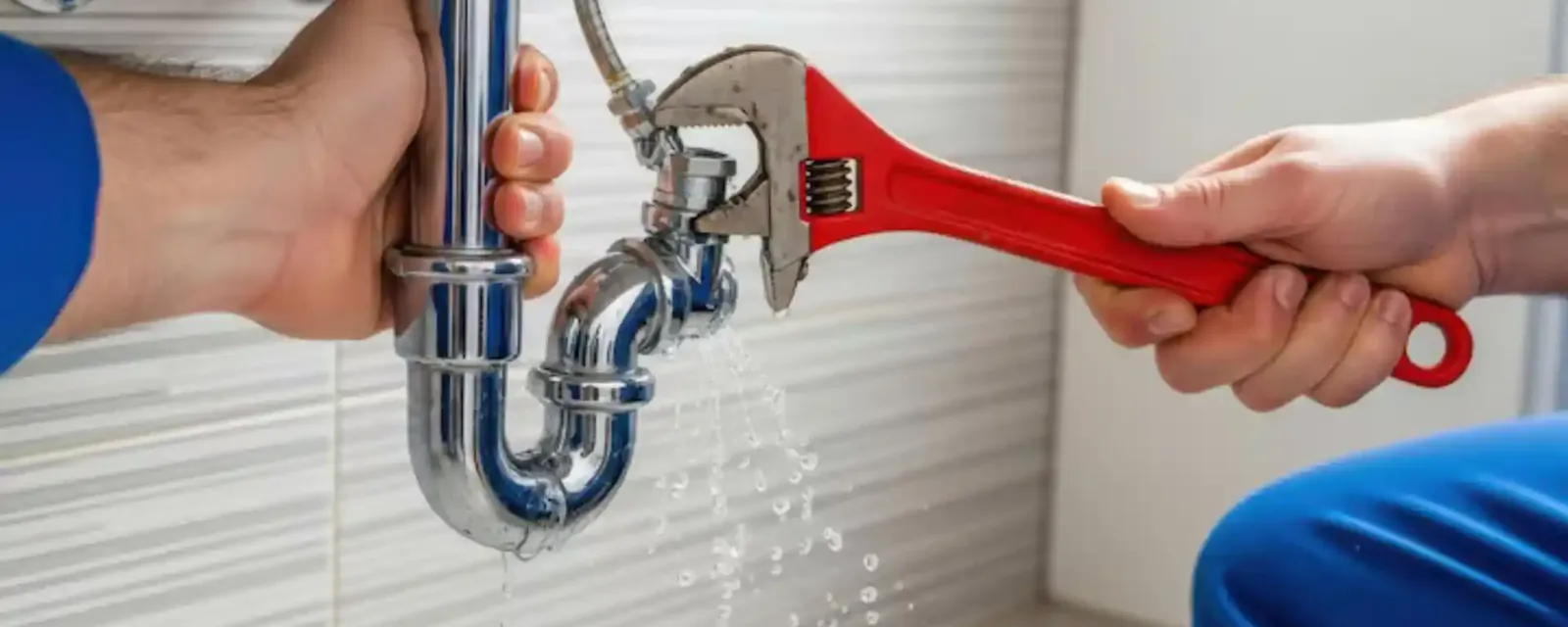
A bathroom sink that will not drain and shows no real clog is most often a pop-up stopper that is not lifting. The stopper sits at the top of the drain, and a lever rod behind the faucet moves it through a linkage under the sink. If the linkage slips or the stopper is jammed with hair, water stays in the bowl even though the pipe below is open.
Other causes are a partial clog in the trap, a venting fault or a cracked pipe. Walk through them in order, from the cheapest check to the most involved.
Start at the stopper
Lift the lever
Pull the lever behind the faucet. Watch whether the stopper moves.
Look under the sink
Find the pivot rod and clevis. A loose nut or a slipped strap stops the lift.
Pull the stopper
Many lift out by turning or after you release the pivot rod. Clean hair and film from it.
Reset and test
Reassemble and adjust the lever so the stopper opens fully.
This one fix solves a great many cases, and it takes minutes. If the stopper lifts freely and the water still sits, the problem is below it.
Other causes when the stopper is fine
| Cause | Clue | Next step |
|---|---|---|
| Hair and soap film in the tailpiece | Water drains slowly, bad smell | Remove the tailpiece and clean it |
| Partial clog in the trap | Gurgle at the sink, water level drops slowly | Open the trap over a bucket |
| Vent blockage | Gurgling, other fixtures slow | Have a plumber check the vent |
| Overflow channel blocked | Water backs up with a slime smell | Clean the overflow hole with a small brush |
| Shared branch line partly clogged | Shower or tub also slow | Cable or jet the branch line |
What not to do
- Do not pour drain chemicals into a standing bowl of water.
- Do not force a metal snake through a plastic trap.
- Do not remove the trap without a bucket and a rag.
- Do not ignore a sink that drains slowly and gurgles, because it may be a vent or a main-line issue.
A plumber's visit covers all of these in one trip. Our drain cleaning page describes how branch lines are cleared and when a camera is used, and our faucet repair page covers the lever and linkage side.
Hard water scale can look like a clog
White crust around the drain flange and slow flow from the faucet can come from mineral scale. Scale narrows the aerator and the pop-up assembly, and it makes a sink seem sluggish with no clog at all.
Soak the aerator in vinegar and scrub the pop-up with a small brush. If scale returns quickly, test your water. Payson City's water report does not list hardness, so a test kit is the way to know.
Older Santaquin homes and long branch drains
Santaquin became a city in 1932, and natural gas arrived in 1954, so some homes there are decades old and have long runs of drain pipe that cross the house. A bathroom at the far end of such a run can slow down when the branch line narrows.
That is a reason to camera a line that repeats, and not just to snake it again. Our Santaquin page describes how we handle older houses, and the same approach applies to older homes near Main Street in Payson. For calls in Salem, the questions are the same about which fixtures are slow.
How to put the sink back together without a leak
After you clean the trap or the tailpiece, hand-tighten the slip nuts and check the washers sit flat. A twisted or pinched washer is the most common cause of a drip after a cleaning. Run water for a minute, then dry each joint with a paper towel and look for dampness.
If a joint seeps, back the nut off and reseat the washer. Overtightening plastic nuts cracks them, so stop when they are snug.
Quick leak test after reassembly
- Fill the basin and let it drain fully.
- Wipe every slip joint with a dry paper towel.
- Check again after ten minutes for any dampness.
- Look at the cabinet floor with a flashlight.
- Run the faucet hard for a minute to push more flow through the trap.
Preventing the next slow drain
A hair catcher in the drain takes seconds to empty and saves the pop-up from jamming. Wipe toothpaste and soap off the stopper and rinse the basin with hot water now and then. If the sink serves a child's bathroom, check the stopper more often.
The International Plumbing Code (IPC) sets the minimum trap size for a bathroom sink at one and a quarter inches, so a replacement trap should match that size and not be cut down.
Sink still full?
Call.
Bathroom sink drain questions
The stopper may not be lifting, or a partial clog below may be slowing the flow. Check the stopper first.
Loosen the nut on the pivot rod, set the lever so the stopper rises about a quarter inch, then tighten the nut. Test and repeat if needed.
If sewage backs up through the sink or other fixtures, stop using water and call. A slow sink alone is not an emergency.
It can loosen light film, but it does not clear hair or a solid clog. It is safe for most pipes, unlike strong chemicals.
Yes. We serve Elk Ridge and the rest of the area, and the line is open every hour.