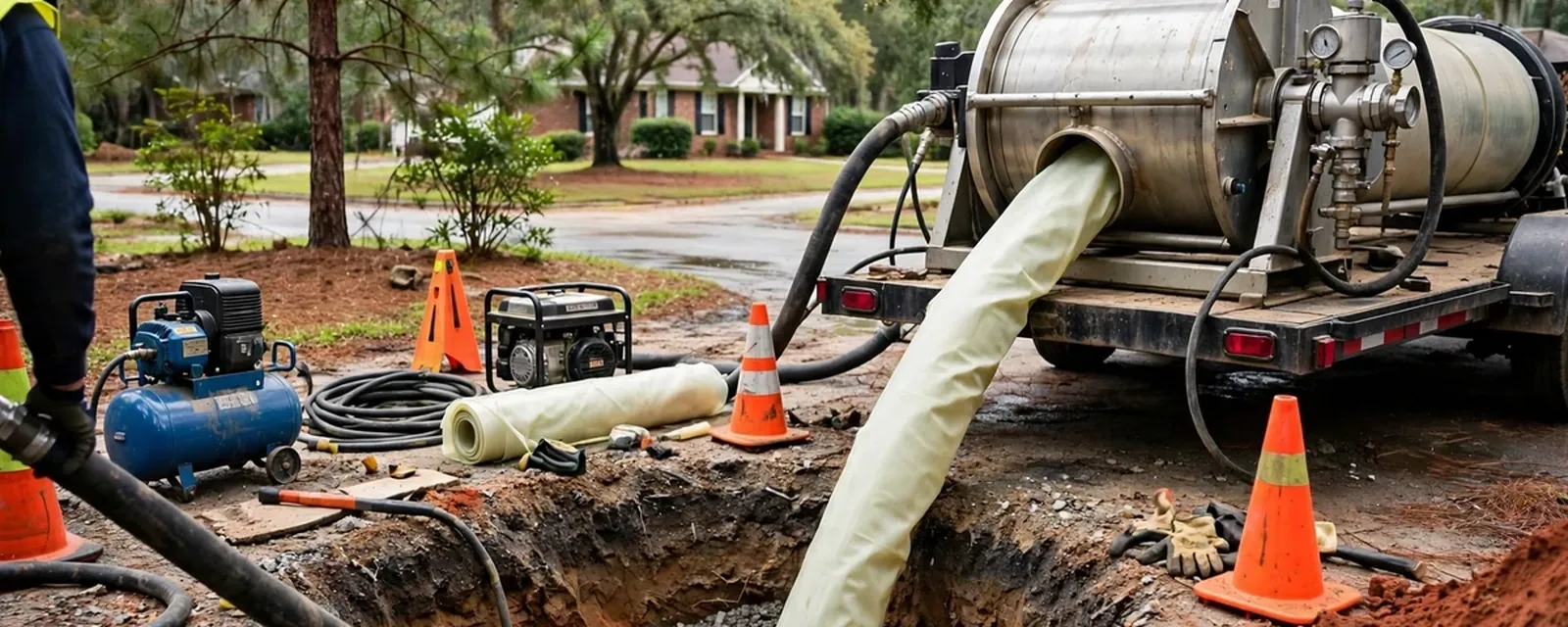
Cured in place pipe lining (CIPP) repairs a damaged sewer line by installing a new resin-coated liner inside the old pipe, so most of the yard stays untouched. The liner hardens against the pipe wall and becomes a smooth pipe inside a pipe. It works well on cracks, joint leaks and root damage. It does not work on every failure, and the camera inspection decides which one you have.
If sewage is already backing up into your home, the first step is not lining. Stop using water and call, then read the rest of this guide when the drain is clear.
How CIPP lining works, step by step
Camera inspection
A camera records the pipe so the crew can see cracks, roots, offsets and the pipe diameter.
Liner install
A felt tube soaked in epoxy resin is pulled or inverted into the pipe through an access point.
Cure and reopen
Hot water, steam or UV light hardens the resin. Side connections are reopened and a final camera pass checks the result.
A typical residential lateral can be lined in a day once the pipe is cleaned and the access point is ready. The work still needs a plan for the days you cannot use water, so ask the crew how long fixtures will be off.
When lining makes sense
Good candidates for a liner
- A pipe with long cracks, small holes or leaking joints but that still holds its shape.
- Root intrusion at joints, after the roots have been cut out.
- Old clay, cast iron or fiber (Orangeburg) pipe that is still round.
- A line under a driveway, patio, mature tree or other surface you want to keep.
- A lateral that is straight enough for the liner to follow.
When you still need a dig
A pipe that has collapsed, separated at a joint or developed a belly that holds water cannot be fixed by lining alone. A liner follows the shape of the old pipe, so it will follow a low spot too.
Lining also needs a defined access point and cannot be installed past a section that has fully fallen in. In those cases we recommend a spot repair, a partial replacement or a full replacement. Our sewer line repair page explains each of those.
| Method | Yard disruption | Best for | Limits |
|---|---|---|---|
| CIPP lining | Small access pit or none | Cracks, roots, leaking joints | Needs a pipe that is still round and clear |
| Open trench replacement | High | Collapsed or badly offset pipe | Digs up the yard, driveway or landscaping |
| Pipe bursting | Moderate, two access pits | Replacing a straight old pipe in place | Needs the right soil and clear surroundings |
| Spot repair | Small excavation | One failed section | Leaves older pipe on either side |
What changes the price of lining
The factors are the length of the lateral, its diameter, how much cleaning it needs, the number of connections to reopen, how deep it runs and how hard it is to reach. Lining generally costs less than a long trench when a surface is hard to restore, and more than a short spot repair. We quote after the camera, because the camera is what tells us what to quote.
What this means in Payson
Payson was founded in 1850, so some of the streets near Main Street and the Peteetneet Museum are well over a century old. Houses on older lots may have clay or cast iron laterals, and houses in the newer subdivisions to the east and in Salem and Santaquin mostly have plastic pipe.
Permit rules vary, so ask the Payson City building department at 439 W Utah Avenue what a sewer repair needs at your address. Elk Ridge and the other towns have their own offices. Say so on the call.
After the liner is in
Once the liner has cured and the connections are reopened, run water through the house and check every drain. A final camera recording shows the finished pipe, and you should receive a copy. Keep it with your records, since a buyer or an insurer may ask for it later.
Avoid planting new trees close to the line, and keep wipes, grease and paper towels out of the drains. A liner makes the pipe tough, but a clog still blocks it.
Lining does not remove the permit step. Ask whether your city treats a liner as a repair under the International Plumbing Code (IPC), and keep the final camera recording as your record.
Sewer line problem?
Call for a camera inspection.
Questions to ask a lining contractor
Ask before you agree
- Will you camera the pipe before and after, and give me the recordings?
- What is the liner's thickness and warranty?
- How do you reopen side connections?
- What happens if the pipe turns out to be collapsed?
- Do you handle the permit, or do I?
If the contractor will not camera the line first, look elsewhere. The recording is the single best protection you have. Our sewer inspection service produces one even if you decide to work with someone else.
CIPP lining questions
Manufacturers rate liners for decades when installed in a clean, sound pipe. The installer's warranty is a better guide for your home, so ask for it in writing.
It seals joints and cracks where roots enter, so roots lose their way in. The roots must be cut out first, and a tree close to the line can still press on the pipe.
Slightly, because the liner has thickness. The smooth surface usually carries water as well as the old pipe did, but a very small pipe has less room to spare.
The cure works in cold weather, but frozen ground makes digging an access pit slower. Ask the crew how they plan for frost and snow cover.