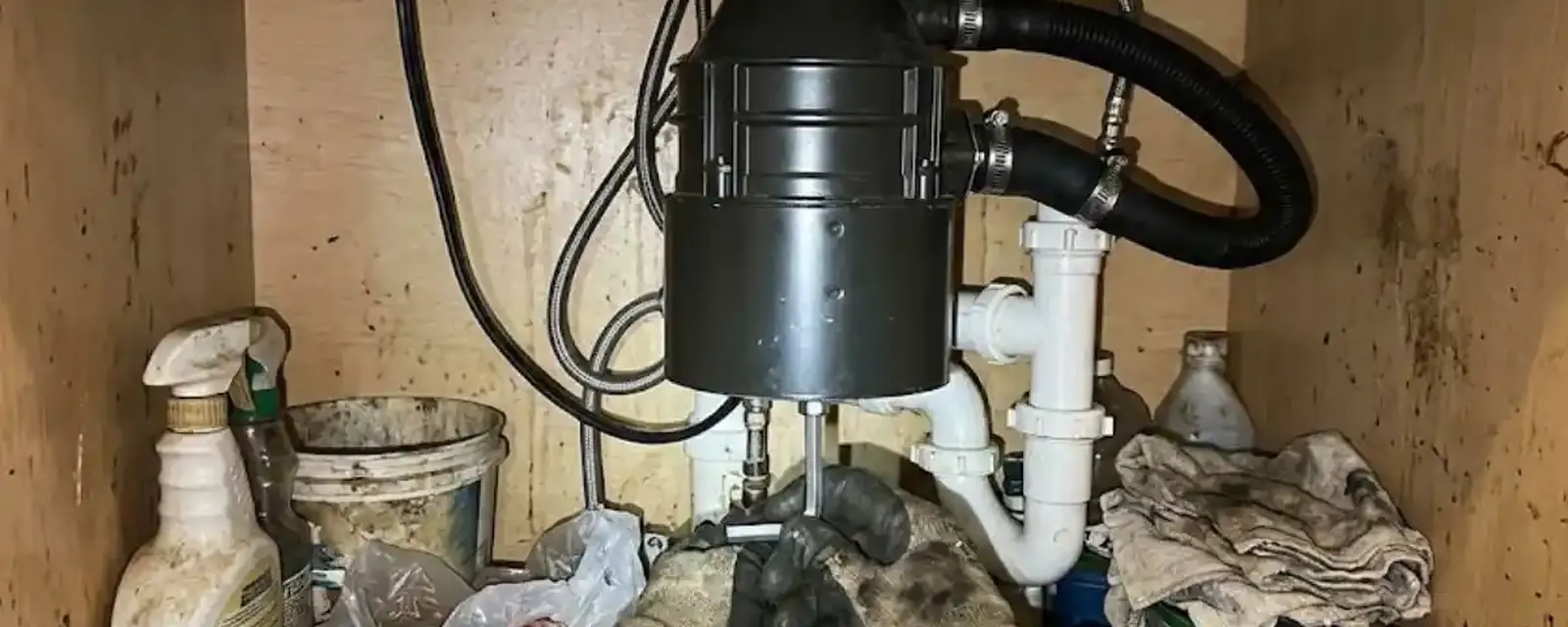
Kitchen sink plumbing with a garbage disposal has a standard layout. The sink drain feeds the disposal, the disposal's outlet leads to a P-trap, and the trap connects to the wall drain. The dishwasher usually drains into the disposal or the tailpiece above the trap. Knowing that order lets you find a leak in a minute and tell a plumber exactly where it is.
A sink full of standing water or a leak under the cabinet during a meal is an emergency for most households. Shut the supply valves under the sink and call.
The parts, from the sink downward
| Part | What it does | Leaks when |
|---|---|---|
| Sink flange | Seals the sink opening to the disposal | Putty or gasket has dried out |
| Disposal | Grinds food waste | The housing cracks or a seal fails |
| Discharge elbow | Connects the disposal to the trap | The gasket or bolts loosen |
| P-trap | Holds water to block sewer gas | A slip nut works loose |
| Dishwasher drain hose | Carries dishwasher water to the disposal | Hose clamp is loose or hose splits |
| Wall stub-out | Joins the trap to the house drain | The connection is worn or clogged |
Where a disposal sink usually goes wrong
Common problems
- Water pooling at the base of the cabinet after running the dishwasher.
- A slow sink that drains faster when the disposal runs.
- A bad smell from the drain, from a dry trap or food in the disposal chamber.
- A hum with no grinding.
- A dishwasher that fills with sink water.
Most of these come from a loose connection or a partial clog. A dishwasher that backs up with sink water points to a poor high loop or a clog beyond the disposal. Our garbage disposal repair page describes how a plumber separates a failing unit from a blocked line.
Double bowl, single trap: how the pieces link
Many kitchen sinks have two bowls, and the second bowl's drain joins the first through a tailpiece tee or a continuous waste. The disposal sits under one bowl. If a bowl without the disposal drains slowly, the clog is probably in the joining pipe or the trap.
Plumbing codes in most places want the trap close to the drain and a vent that lets air in behind the water. A sink that gurgles when the dishwasher drains suggests a venting problem, which is a job for a plumber, not a plunger.
Installing a new disposal on an existing sink
Check fit
Confirm the sink opening, drain size and nearby outlet and switch.
Mount
Fit the flange with fresh putty and set the mounting ring.
Connect
Attach the dishwasher hose, the discharge elbow and the trap.
Test
Fill the sink, run the disposal and the dishwasher and check every joint.
Kitchens and the local water supply
Payson City's supply comes from nine springs in Payson Canyon and four wells. The city's report does not list hardness, so test your tap. Mineral scale on faucet aerators can mimic low flow, and a quick vinegar soak helps you tell scale from a clog.
Salem and Santaquin households use different water systems, and every one of them runs the same dishwasher-to-disposal layout described here. If your kitchen drain backs up in an older home, a camera helps, and our drain cleaning page shows what that visit involves. Our Salem page covers calls from the north side of the valley.
Simple habits that keep a disposal sink working
Most kitchen drain trouble comes from what goes down, not from the pipes. Grease cools and sticks to the walls of the trap and the branch line, and fibrous food like celery or potato peels can wrap around the blades.
Run cold water while the disposal grinds and for a few seconds after. Cold water keeps fats solid so they move through the pipe instead of coating it.
Do and don't
- Scrape plates into the trash before rinsing.
- Wipe greasy pans with a paper towel before washing.
- Cut large scraps small before grinding them.
- Skip bones, fruit pits and shells.
- Keep a bottle of dish soap nearby and run hot water after greasy dishes.
Signs that the problem is the line, not the sink
If the kitchen sink backs up and the laundry sink or a floor drain downstream gurgles at the same time, the clog is past the sink. A cable run from the cleanout is the right tool, not another trap cleaning.
Take note of which fixtures are affected, since that tells the plumber how far down the line to look. A kitchen on its own branch is a simpler job than a kitchen that shares a line with a laundry and a bathroom.
The IPC limits how far a trap can sit from its vent, which is why a sink moved a long way from the wall may gurgle. A plumber checks that distance when a kitchen is remodeled.
Kitchen sink backed up?
Call.
Kitchen sink plumbing questions
Often, yes. The hose joins a port on the disposal. A new disposal has a knockout plug that must be removed, or the dishwasher will not drain.
The drain hose may be kinked, the high loop may be missing or the line beyond the disposal may be clogged.
Usually, yes. You need a standard sink opening, power nearby and a trap in good shape.
Food residue causes most smells. Run cold water and grind ice, then clean the chamber. A persistent smell can mean a dry trap or a line problem.