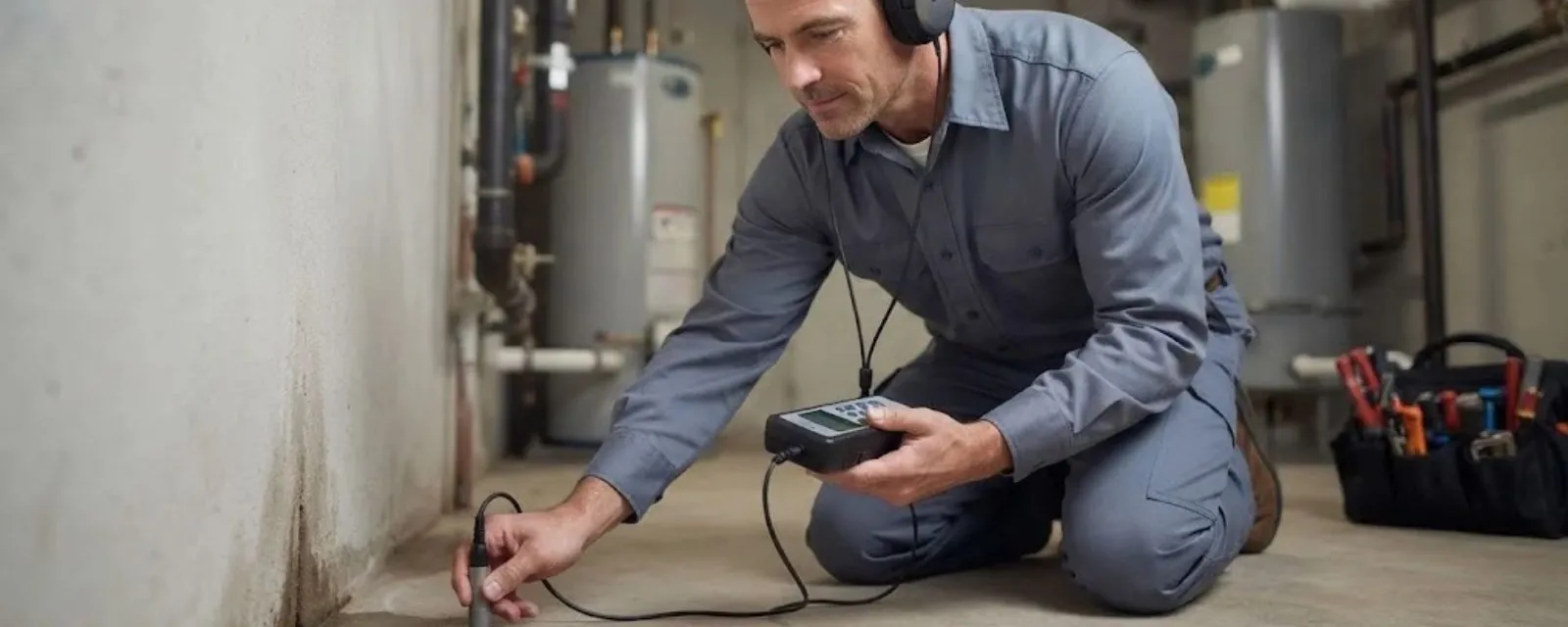
Leak detection in Payson, UT is the process of finding where water is escaping from a supply line, drain, slab or buried pipe before any wall, floor or yard is opened. A plumber uses acoustic listening gear, pressure testing, thermal imaging and tracer methods to locate the leak within a small area.
Most calls start with a symptom, not a diagnosis. The water bill went up. The meter keeps turning with every tap closed. A patch of floor feels warm. A stain appears on a ceiling. Call and describe the problem. Ask what help is available for your address.
A leak you can see: stop the water first
Active leak steps while you wait
- Locate your main water shutoff, usually where the line enters the house, and turn it clockwise to close.
- Open a faucet at the lowest point of the house to drain the line and relieve pressure.
- Switch off power to wet areas at the breaker panel only if the panel itself is dry.
- Move furniture, electronics and rugs out of the wet area.
- Take photographs of the damage and the water meter reading for insurance.
The water meter test: is there a hidden leak?
Turn off every tap, appliance and irrigation valve in the house. Find the water meter, usually in a box near the street, and look at the small leak indicator or the dial. If it moves while nothing is on, water is escaping somewhere between the meter and your fixtures.
That test splits the problem in half. A moving meter with the house valve closed means the leak is outside, between the meter and the house. A meter that stops when the house valve closes but moves when it opens points inside the home. We start there.
High water bill with no visible leak
A bill that climbs slowly is often a toilet flapper that does not seat, a slow drip at a hose bib or a pinhole in a copper line. A bill that jumps may point to a broken irrigation line or a slab leak.
Compare this month's usage to the same month last year, not to last month. Summer irrigation changes use a great deal. If winter usage rises with no change in the household, treat it as a leak until proven otherwise.
Where leaks hide and how we find them
| Location | Typical signs | How we find it |
|---|---|---|
| Ceiling or wall | Stain, bubbling paint, musty smell, sound of running water | Moisture meter, thermal camera, acoustic listening |
| Under a slab | Warm spots on the floor, running meter, hissing at night | Acoustic correlation and pressure isolation tests |
| Under the house or crawl space | Damp insulation, pooling water, mold odor | Visual inspection, moisture mapping, line pressure test |
| Buried service line | Wet soil, sinking ground, low pressure, running meter | Acoustic ground microphone, tracer gas where needed |
| Irrigation line | Soggy lawn, low zone pressure, spiking summer bill | Zone isolation and pressure testing |
Ceiling, wall and attic leaks
Water travels. A stain on a ceiling can sit several feet from the source because the water ran along a joist or a pipe before it dripped. We trace the stain back to a supply line, a drain, a shower pan or a roof penetration. If the source is a roof leak, that is a roofer's job, and we say so and stop charging for a plumbing diagnosis we cannot fix.
Slab, crawl space and under-house leaks
Warm patches on a slab floor, the sound of running water at night and a meter that moves when the house is off all suggest a slab leak. Hot water lines under concrete fail more often than cold ones because of heat and movement.
In a crawl space or under a house the signs are visible. Damp insulation, standing water or a musty smell mean a supply or drain leak below the floor. We find the exact joint, so a repair does not mean tearing up more than it must.
Buried lines, irrigation and yard leaks
The line from the meter to the house is buried and often runs for dozens of feet. A leak there wastes water continuously and can undermine soil around the house. We use ground microphones and, where needed, tracer methods to mark the spot before excavation. Our water service line repair page covers fixing it.
Spring is when irrigation leaks show up in Payson, Salem and Santaquin, when systems are charged and zones are tested. A soggy patch of lawn or one zone with weak pressure usually points at a broken sprinkler line or a failed valve, and isolating each zone with a pressure test finds it fast.
Pool, spa and meter-box leaks
If you have a pool or spa, a drop in water level beyond normal evaporation can mean a leak in the shell, skimmer line or plumbing. We test the supply and return plumbing. A leak in a meter box near the curb is another common source, since the fittings there are exposed to weather and ground movement.
What affects the price of leak detection
We quote before we start. Here is what moves the number.
Some insurance policies cover the cost of finding a covered leak, others only cover the damage. Ask before you file a claim. Call (385) 488-1892 for your number.
Plumbing codes such as the International Plumbing Code (IPC) require new systems to be tested for leaks with water or air at set pressures. Pressure testing is also the plain way to confirm whether an existing line is losing water.
Water going somewhere it should not?
Call.
Leak detection questions
Yes. Call and ask what help is available. If water is running, shut off the main valve and call (385) 488-1892. Ask for the price before work starts.
The usual signs are a warm floor spot, the sound of water running when everything is off, a meter that keeps moving and a bill that climbs without explanation. A plumber confirms it with listening equipment and pressure tests.
In most cases, yes. Acoustic tools, thermal imaging and moisture meters locate a leak within a small area. We open only the spot that needs repair, which keeps drywall and floor damage small.
Not first. Check inside the house for leaks with the main valve test. If the problem is in the line from the meter to the house, that section is usually the homeowner's. The water office can tell you where the city's responsibility ends.