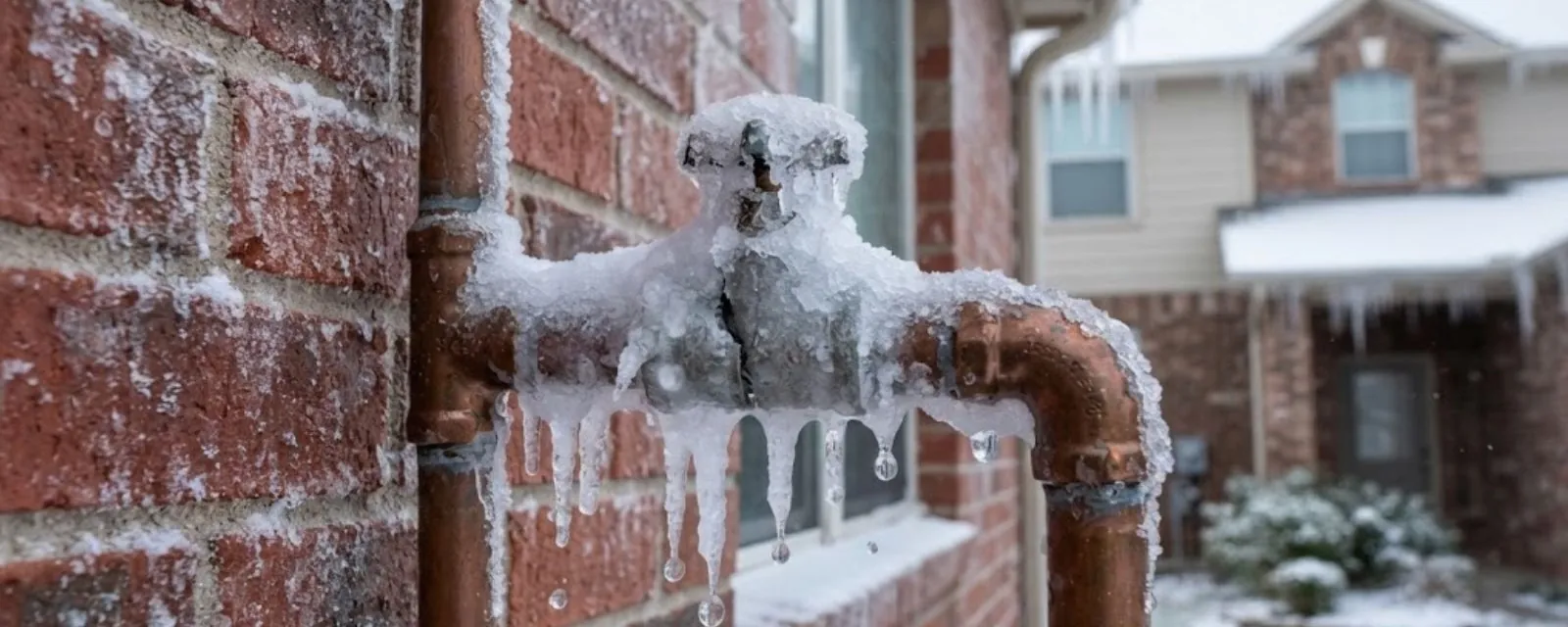
An outdoor faucet repair starts with finding where it leaks. A drip from the spout means a worn washer or seat. A leak around the handle means a worn packing washer or a loose packing nut. Water inside the house when the faucet is on means a split pipe behind the wall. Matching the part to the leak saves money and tells you when to call a plumber.
If you turn on an outdoor faucet in spring and water appears in the basement or on the wall, close the interior shutoff right away and call.
Parts that wear out, and what they do
| Part | Where it sits | Failure sign |
|---|---|---|
| Washer | At the end of the stem, against the seat | Drips from the spout when closed |
| Packing washer or packing nut | Around the stem under the handle | Leaks around the handle when on |
| Stem | Inside the faucet body | Handle spins without effect or won't shut |
| Vacuum breaker | On the spout of an anti-siphon bib | Spits water from the cap |
| Frost-free stem | A long stem inside the wall | Water inside the wall after freezing |
| Shutoff valve inside | Indoors on the supply line | Seized or leaking, so you can't isolate the faucet |
A simple repair, in order
Shut off the supply
Close the interior valve if there is one. Open the faucet to drain.
Open the faucet
Remove the handle and packing nut and pull out the stem.
Replace the washer
Match the washer and packing. Take the old parts to the hardware store.
Reassemble and test
Tighten the nut and turn the water on slowly. Check for drips.
If the stem is corroded or the body is cracked, a repair will not hold. A new faucet is the answer. Our faucet repair page covers outdoor fixtures along with sinks, and our burst pipe repair page explains what happens if a split pipe is found behind the wall.
Frost-free or standard? Why it matters
A standard hose bib has its valve seat at the outside wall. In a hard freeze, water inside the spout freezes and splits the faucet or the pipe behind it. A frost-free bib has a long stem that puts the seat inside the warm part of the wall, so no water sits in the exposed section.
A frost-free bib must slope slightly downhill so that it drains. If a hose stays attached, water stays in the spout and the benefit is lost. Disconnect hoses before the first freeze in every case.
Fall checklist for outdoor faucets
- Disconnect and drain every hose and splitter.
- Shut off the interior valve, if there is one, and open the outdoor faucet to drain.
- Cover standard bibs with an insulated cap.
- Look for staining or damp drywall behind the faucet.
- Replace any faucet that drips from the spout or leaks around the handle.
Freezes, canals and spring turn-on
Elk Ridge sits at about 5,361 feet and Payson at 4,669 feet, so the hillside sees hard freezes earlier than the valley. Salem has a city irrigation system that delivers canal water for outdoor use, built in 2008, and when it is switched on each spring, pressure changes can shake loose old fittings.
Check each outdoor faucet and sprinkler connection when irrigation season starts. If one drips inside the wall, shut off the interior valve and call. Our Elk Ridge page and Salem page explain how we handle seasonal calls.
Choosing a replacement faucet
Match the new faucet to the pipe type. Threaded, sweat and push-fit connections each need the right fitting. If you are unsure, take a photo of the old faucet, the wall behind it and the pipe type to the store or send it to a plumber.
Pick a frost-free model with a stem long enough for your wall thickness. A stem that is too short leaves the valve seat in the cold part of the wall, which defeats the point of the design.
What to look for in a new hose bib
- A built-in vacuum breaker, which most codes require on hose connections.
- Brass construction instead of a thin plated body.
- A stem length that matches your wall thickness.
- A quarter-turn handle if you want faster shutoff.
- A downward slope when installed, so the stem drains.
When to leave it to a plumber
A seized stem, a corroded body or a leak inside the wall is beyond a washer swap. Forcing a stuck stem can twist the pipe behind the wall, turning a small leak into a large one.
If the faucet is attached to a copper line, cutting it out and fitting a new bib takes soldering or push-fit fittings and a check for a sound pipe behind it. That is a short visit for a plumber and a risky weekend project for most owners.
According to the International Plumbing Code (IPC), hose connections need backflow protection, which is the vacuum breaker on most outdoor faucets. Keep it in place when you swap parts.
Water inside the wall?
Close the interior valve and call.
Outdoor faucet questions
If the faucet leaks inside the house when turned on, the pipe behind it has likely split. Turn off the interior valve and call.
Often, yes. A washer or packing change is a small job. If the faucet is corroded, replace it.
A device that prevents dirty water from flowing back into the house supply. It may spit water when the faucet is on, which is normal for some designs.
Before the first hard freeze in autumn. Hillside homes such as those in Elk Ridge can see freezes earlier than the valley.
Yes. We serve Santaquin and install frost-free bibs where the wall allows.