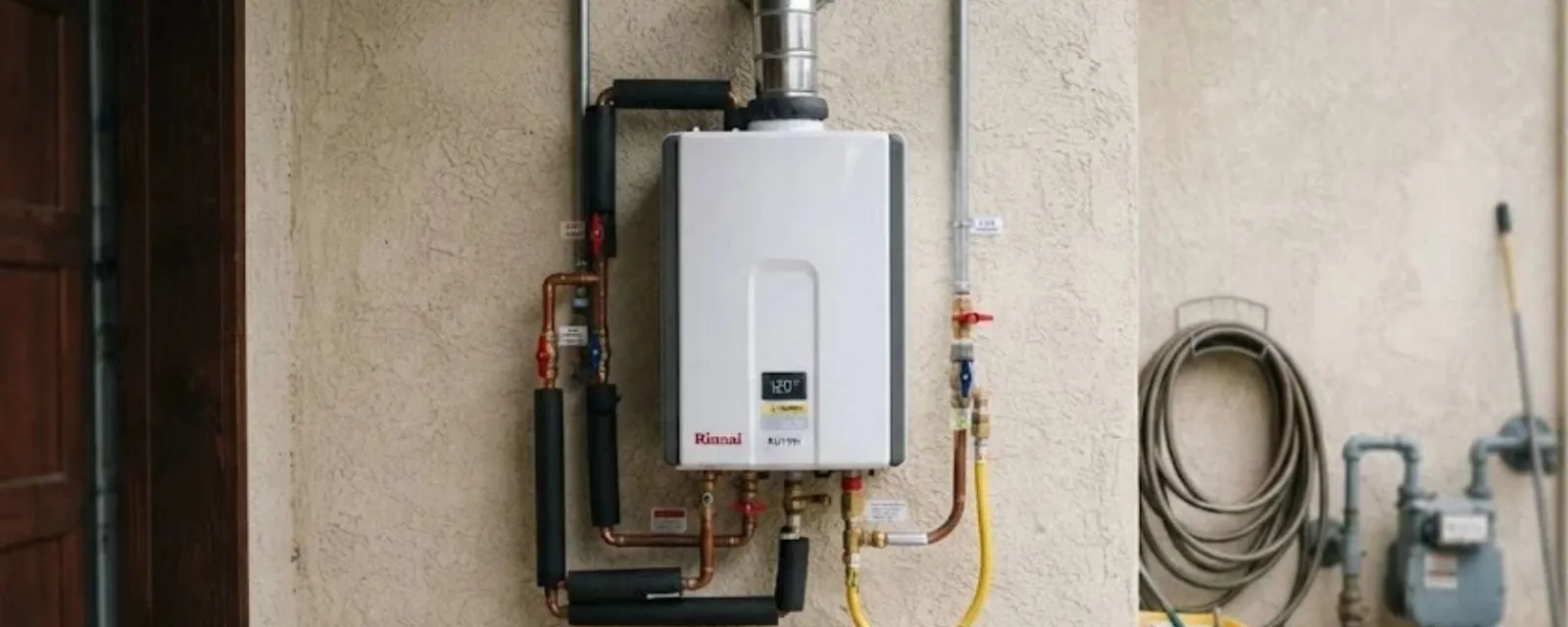
Tankless water heater service in Payson, UT covers installing a new unit, repairing a fault code and flushing the heat exchanger. A tankless heater warms water only when a tap opens, so it has no storage tank to corrode or leak, and a well-kept unit commonly lasts longer than a standard tank.
Many homeowners call us after another company declined to service a tankless unit they had not installed. We work on gas and electric models, and we tell you honestly when a repair makes sense and when replacement does.
How a tankless heater works and what it needs
Cold water enters the unit, a flow sensor detects it and a burner or electric element heats it as it passes through. The unit must deliver the temperature rise you need at the flow rate you use. A shower, a dishwasher and a washing machine running together demand more than a single tap does.
Gas units need a large enough gas line and special venting, because the burner is more powerful than a tank's. Electric units need heavy dedicated circuits. These upgrades are the reason tankless installs cost more than tank swaps.
Flushing and descaling: the service most tankless owners skip
Minerals in water leave a scale coating inside the heat exchanger, much like a kettle. The coating insulates the metal, so the unit works harder, throws error codes and eventually fails. Flushing the exchanger with a mild acid solution dissolves the scale and restores performance.
Payson and Santaquin publish annual drinking water quality reports, and the recent editions we checked do not list a hardness figure. The reliable way to know is to test your tap with a hardness test kit or to ask your water utility. If your water is hard, flush more often.
Signs your tankless unit needs a flush
- Water takes longer to heat or never reaches the set temperature.
- The unit shows an error code, often related to temperature or flow.
- Hot water runs lukewarm when two fixtures are open.
- The unit is noisy or rumbles when it fires.
- It has not been flushed in a year or more.
Tankless versus tank: an honest comparison
| Tankless | Standard tank | |
|---|---|---|
| Hot water supply | On demand, never runs out at a single fixture | Limited to tank size, then recovery |
| Upfront cost | Higher, often with gas or electrical upgrades | Lower |
| Space | Wall-mounted, small footprint | Floor-standing, large footprint |
| Typical lifespan | Longer when flushed regularly | Roughly 8 to 12 years |
| Maintenance | Annual flush is important | Occasional flush and anode rod check |
| Failure mode | Scale, sensors, ignition faults | Tank corrosion and leaks |
If you want a conventional unit instead, see water heater installation or water heater replacement.
Hybrid, electric and gas models: choosing what fits
A gas tankless unit is the usual choice for homes with an existing gas supply. It delivers high flow, but venting must be correct and the gas line must be sized for it. Electric tankless units avoid venting but draw a lot of power at once, and not every panel can handle it.
If you are weighing options, we visit, look at the gas line, panel and layout, and write a quote. You decide with the real numbers in hand.
Tankless problems we repair
Error codes
We read the code, check the sensors, igniter, flame rod and venting, and fix the fault.
Cold water sandwich
A brief burst of cold water between hot flows. Often a settings or sensor issue.
Low flow
Clogged inlet screens and scaled exchangers reduce flow. Both are serviceable.
Leaks
Fittings and relief valves can leak. A leaking heat exchanger usually means replacement.
What affects the cost of tankless service
We quote before we begin.
Manufacturer warranties may require documented annual maintenance. Check your paperwork. Call (385) 488-1892 for your number.
Tankless units draw more gas at once, and gas piping and venting are governed by the International Fuel Gas Code, part of the 2021 set Utah adopted. That is why the gas line size has to be checked before you buy.
Tankless unit acting up?
Call and describe the code or symptom.
Tankless water heater questions
A yearly flush is the common recommendation, and homes with hard water may need it more often. If you are unsure about your water, test your tap or ask your water utility for its hardness figure.
Yes. We service gas and electric tankless heaters from most major makers regardless of who installed them. We read the model and error history before quoting.
Yes. Call and describe the problem. If your tankless unit shuts down in cold weather, call and ask how soon it can be looked at, and ask for the price before work begins.
It depends on usage, gas line and panel capacity, and how long you plan to stay. We can visit and give you honest numbers for both tank and tankless.