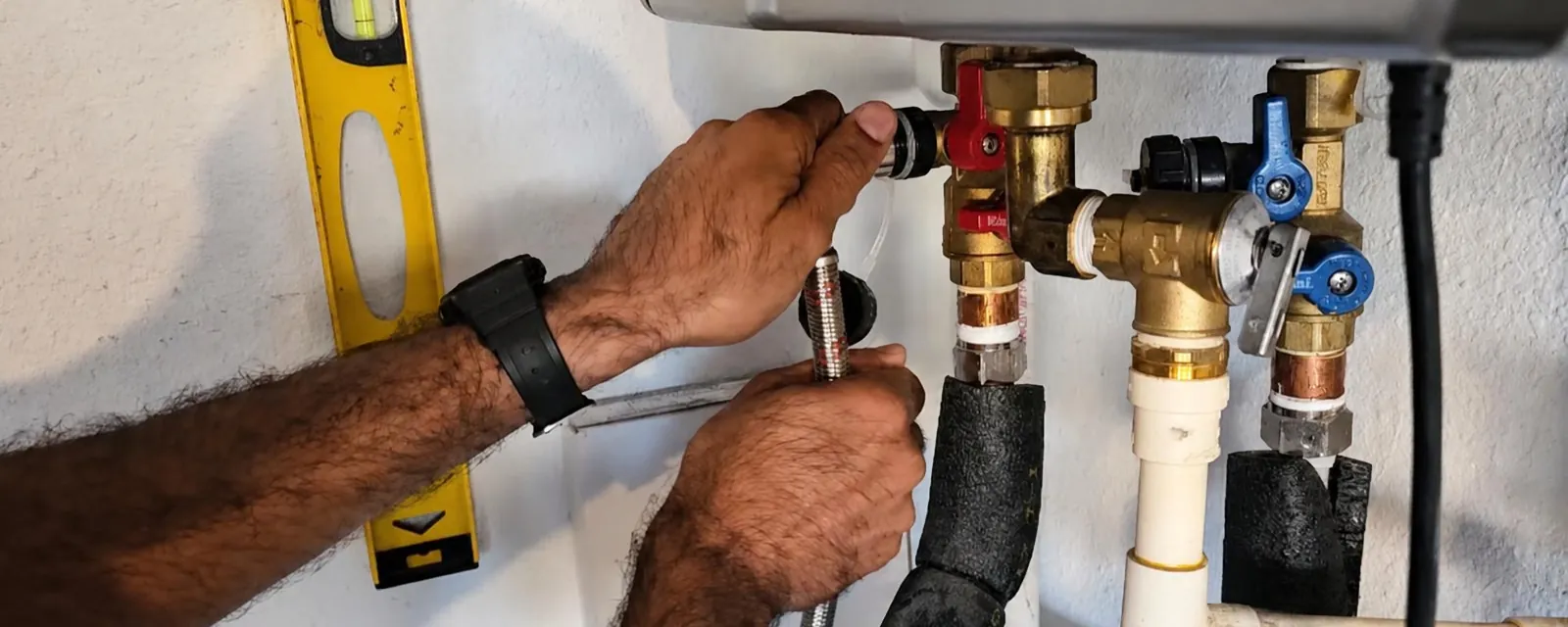
A tankless water heater leaking from the relief valve usually has one of three causes: water pressure that is too high, thermal expansion in a closed system or a worn valve. The valve opens to protect the unit, so a drip means it sensed a condition worth checking. Do not plug the valve or its discharge pipe.
If the water is hot, spraying or near electrical parts, shut off the unit's power and gas, close the cold water and call.
Safe first steps
- Switch off power to the unit at the breaker, and set the gas control to off if it is gas-fired.
- Close the cold water supply valve on the heater's inlet.
- Do not touch hot water or discharge piping.
- Note whether the leak is steady or only after use, and photograph it.
- Call and read the model number from the label if you can.
Three causes, and what each looks like
| Cause | Clue | Fix |
|---|---|---|
| High incoming water pressure | Drips when no hot water is running, any time of day | Test pressure, fit a pressure reducing valve |
| Thermal expansion | Drips right after a hot water draw | Add an expansion tank or relief path |
| Worn or scaled valve | Drips with normal pressure | Replace the relief valve |
| Overheating | Hot discharge, error codes | Service the unit, descale, check controls |
Note that tankless units are often installed with a small recirculating loop, and those loops can create pressure swings. A plumber checks them. Our tankless water heater page explains service and flushing, and our water heater repair page covers repairs on tank models.
Check the water pressure first
Attach a gauge
Screw a pressure gauge onto an outdoor faucet with nothing else running.
Read the number
A reading above about 80 psi is high for most homes.
Check at night
Pressure can rise when demand drops, so test at different times.
Fit a regulator
A pressure reducing valve brings the line back to a safe range.
Descaling and the relief valve
Mineral scale builds inside the heat exchanger and can coat a relief valve seat. A scaled seat does not close tightly, and the valve weeps. A flush with a descaling solution helps the unit and may stop a light drip.
If you have not flushed the unit in over a year, do so or schedule it. If the valve still leaks after a flush, it likely needs to be replaced as a part.
Hillside pressure in Elk Ridge and Payson
Water pressure rises about 0.43 psi for each foot you go downhill, and Elk Ridge sits roughly 700 feet above Payson. A home low on a sloped street can see far higher pressure than a neighbor higher up. High pressure is the most common reason a relief valve weeps.
Pressure differs from town to town and street to street, so measure at your own house. Our Elk Ridge page explains how we measure it, and homes in Salem on the sloped benches can see the same effect. A pressure reducing valve is a modest, long-lasting fix.
What a service visit covers
A plumber starts by confirming where the water is coming from. The relief valve may be dripping because of pressure, or the leak may be from a fitting above it. The visit covers a pressure test, an expansion check, a look at the discharge line and a check of error codes on the display.
The plumber also looks at the isolation valves, the filter screen on the cold inlet and the condensate drain on a high-efficiency model. A clogged filter can raise pressure inside the unit and cause the valve to weep.
Information that speeds up the visit
- The brand and model number from the label.
- The date it was installed, if known.
- Any error code showing on the display.
- Whether the leak happens only after hot water use.
- Whether the house has a pressure reducing valve or an expansion tank.
With that information, the plumber can bring the right valve, the right fittings and the right test gauge on the first trip.
What not to do while you wait
Do not tighten the relief valve, add a cap or replace it with a plug. Do not open the unit's cabinet unless you know how to isolate power. Do not run the unit dry by closing the inlet while the burner is on.
Set the power and gas to off, keep the cold shutoff closed and use the hot tap sparingly if the unit is part of a recirculation loop. If the leak stops once the unit is off, tell the plumber, because it points toward pressure or heat as the cause.
The IPC requires a thermal expansion tank where a check valve or regulator closes the water system. If your tankless unit sits on a closed system with none, expansion is a likely reason for the weeping.
Relief valve dripping?
Call.
Tankless relief valve questions
It can be. The valve opens to protect the unit, so find out why. If the water is hot or spraying, shut off power and gas and call.
No. Blocking it removes a safety device. The discharge must stay open and pipe to a safe location.
If your house has a check valve or pressure reducing valve, thermal expansion has nowhere to go. A plumber can tell you.
Many makers suggest about once a year, and more often with hard water. Check your manual and test your tap.