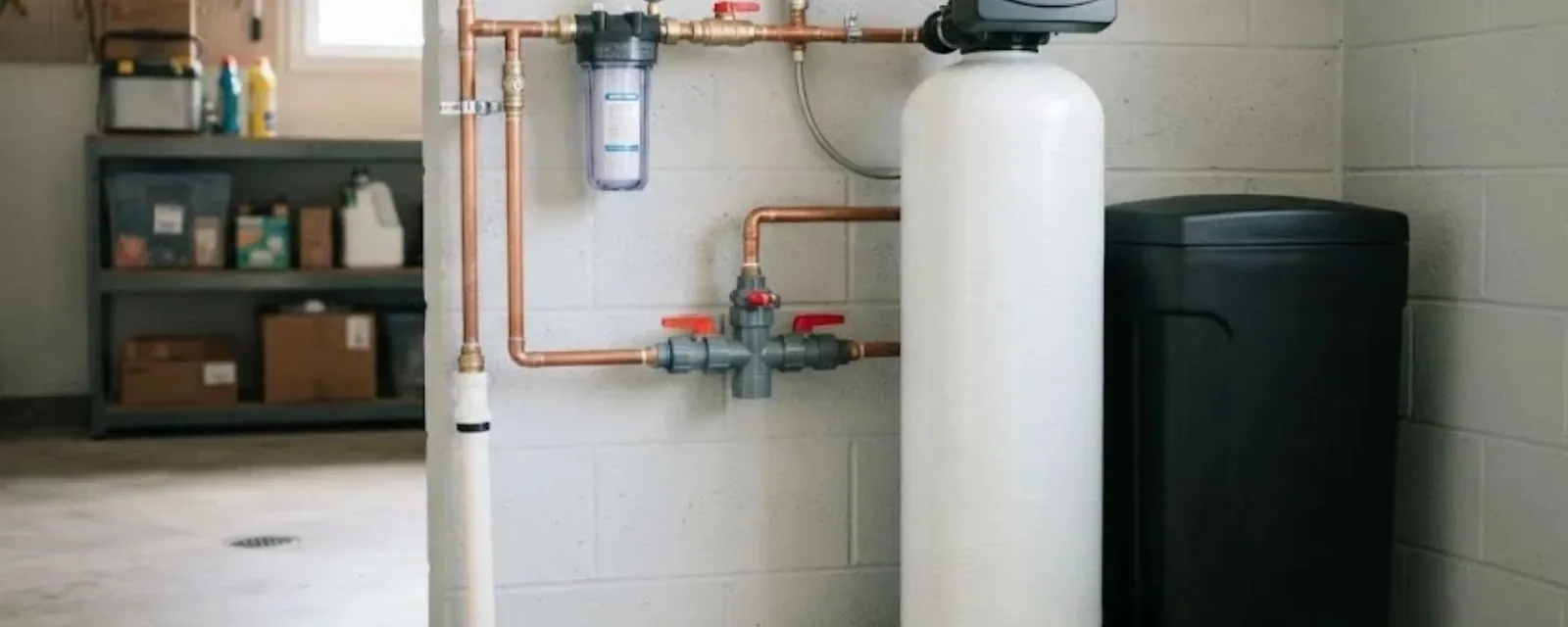
Water softener installation in Payson, UT starts with finding out what is actually in your water. A softener removes hardness minerals, a filter removes particles or tastes and an osmosis system treats drinking water at one tap. Each solves a different problem, and buying the wrong one wastes money.
Payson City's most recent annual drinking water quality report says the supply comes from nine springs in Payson Canyon and four wells in the city. The report does not list a hardness figure, so we recommend testing your own tap before you buy a system.
Test your tap first
A hardness test kit from a hardware store gives a reading in grains per gallon or parts per million in minutes. A lab test gives more detail, including iron, chlorine and other minerals. You can also ask your water utility for its latest report and for any hardness information it has.
Salem City's water comes from wells and springs. Santaquin's 2024 report says its supply is four springs and two wells, with chlorine added to control microbes. Elk Ridge runs three wells. Each system is different, and so is each house after the water passes through its pipes.
Signs of hard water
- White crust on faucets, showerheads and kettles.
- Spots on glasses and dishes after the dishwasher.
- Soap that does not lather well and leaves a film.
- Scale inside the water heater, often heard as rumbling.
- Dry skin and hair after showering, or stiff laundry.
Softener, filter or osmosis: what each does
| System | What it does | What it does not do |
|---|---|---|
| Salt-based softener | Removes calcium and magnesium that cause scale | Does not remove chlorine, bacteria or most chemicals |
| Whole-house carbon filter | Reduces chlorine taste and odor | Does not soften water |
| Sediment filter | Catches sand and particles | Does not remove dissolved minerals |
| Reverse osmosis at one tap | Reduces many dissolved solids for drinking water | Treats one tap, produces wastewater |
| Scale control device | Reduces how scale sticks to surfaces | Does not remove hardness minerals |
Softener installation and what we set up
Choose location
Near the main water entry with drain access and a power outlet.
Install bypass
A bypass valve lets you isolate the unit for service.
Connect drain
A proper air gap protects against backflow.
Program and test
We set hardness and regeneration and verify the soft water.
If you have a well or an older water heater, ask us to check whether hard water has already scaled it. Heavy scale may mean the heater needs a flush or replacement.
Softener and filter repairs
Softeners fail at the control valve, the resin bed, the brine tank and the drain line. A salt bridge, a hard crust that blocks the salt from dissolving, is a common problem and simple to fix. We service most brands and tell you honestly if a unit is worn out.
What affects the cost of a water softener or filter
We quote before starting.
Insurance does not cover water treatment equipment. Call (385) 488-1892 for your number.
Water treatment drain lines need an air gap under the International Plumbing Code (IPC), which keeps waste water from flowing back into the unit. Ask for it in the quote.
Considering a softener?
Call to talk about your water.
Water softener questions
Payson's recent annual water quality report does not list a hardness figure. Test your tap with a kit or ask the city water office at 439 W Utah Avenue. A plumber can also test it during a visit if you ask.
A salt-based softener adds a small amount of sodium. People on strict low-sodium diets may want a bypassed drinking tap or an osmosis system.
Taste and hardness are different. Water can taste fine and still leave scale on your water heater. Test to decide.
Yes. We service most brands and tell you if the unit is past repair.