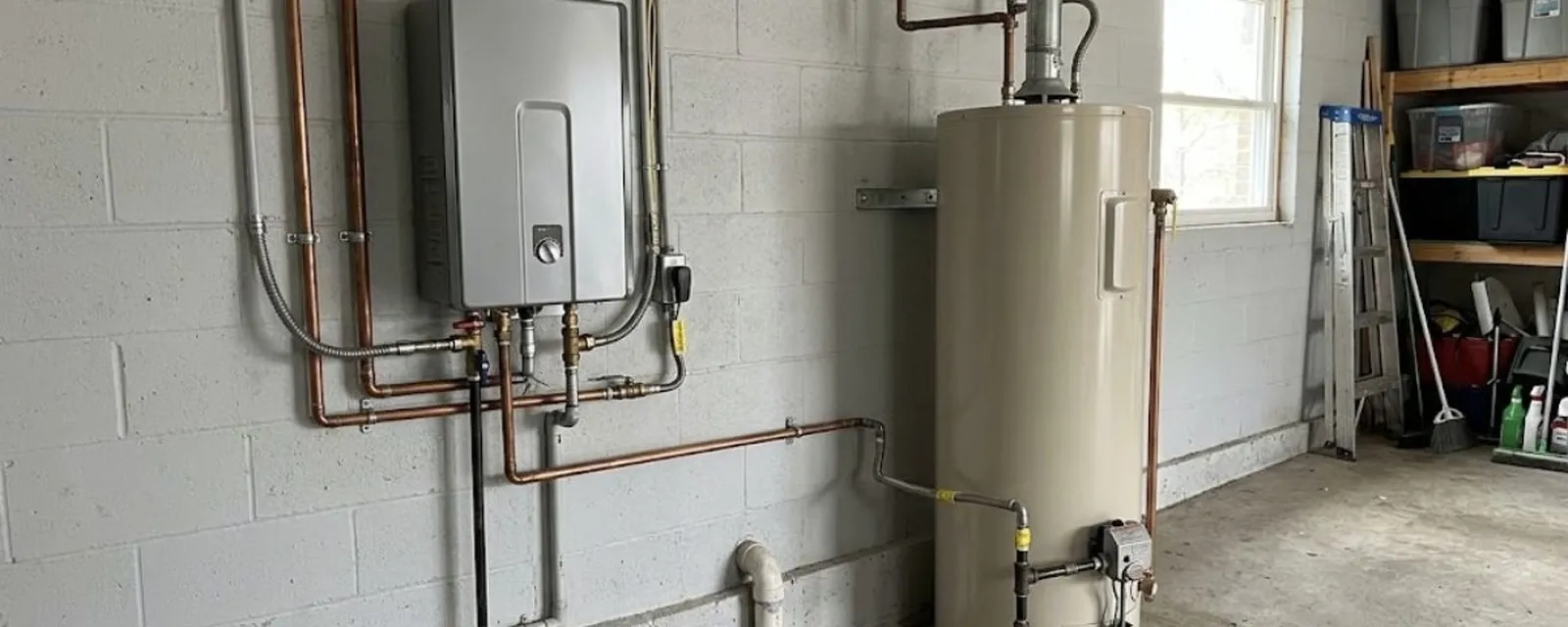
Tankless water heaters heat water on demand instead of storing it, and that has real benefits. It also has real downsides, and the main ones are higher upfront cost, gas and venting changes, a limit on how much hot water you can run at once and colder incoming water in winter. A tankless unit is a good choice for some Payson homes and the wrong choice for others.
This guide is written for homeowners deciding between a tank and a tankless unit. If you already have no hot water and need help now, call.
The main downsides of a tankless heater
Higher upfront cost
The unit costs more than a tank, and installation often costs more too.
Gas and vent upgrades
Many tankless units need a larger gas line and special venting. A house piped for a tank may need work.
Flow limit
A tankless heater can only heat so much water per minute. Two showers and a dishwasher at once can overload a small unit.
Cold-water sandwich
Warm water can briefly turn cold between short uses, and a delay waiting for hot water can feel longer.
Scale and maintenance
Mineral buildup in the heat exchanger needs a periodic flush.
Power dependence
Most units need electricity to run, so a power outage stops hot water.
Winter inlet water in Payson matters
A tankless unit raises the temperature of the water entering the house by a fixed number of degrees. In winter that incoming water is colder, so the heater has to work harder to reach the temperature you set. A unit sized for summer can fall short on a January morning.
Payson sits at 4,669 feet, and Elk Ridge is about 5,361 feet. Cold-weather performance should be part of any sizing talk, so ask for a unit sized for winter flow and not an average. Our tankless water heater page explains sizing and flushing.
| Factor | Tank heater | Tankless heater |
|---|---|---|
| Upfront cost | Lower | Higher |
| Space | Needs floor space | Wall mount, small footprint |
| Hot water at once | Limited by tank size | Limited by flow rate |
| Standby loss | Some heat loss from the tank | No tank to keep hot |
| Winter performance | Tank is already warm | Depends on inlet temperature and unit size |
| Maintenance | Anode and flush | Descale and flush, filter clean |
| Power outage | Gas models can still heat | Most stop without power |
Who should think twice
Cases where a tank may be the better choice
- A large household that runs several fixtures at once.
- A house with a small gas line that would need major work.
- A home with hard water and no plan for maintenance.
- A budget that cannot absorb the install cost.
- A hillside or cold-climate home where inlet water is very cold.
None of this means a tankless heater is a mistake. It means the right answer depends on your house. A smaller household that wants space back and lower standby loss may be well served. We give an honest recommendation, including a tank when that is the better fit. See our page on water heater installation for what a swap involves.
Hard water and the flush plan
Payson City reports that its supply comes from nine springs in Payson Canyon and four wells, and that report does not list a hardness figure. Test your own tap before you choose a tankless unit, because scale is the main enemy of the heat exchanger.
Santaquin's report lists four springs and two wells with chlorine added, and Elk Ridge runs three wells. A flush every year or so is a common maker recommendation, and we explain the schedule for your unit. If you want a softener, our water softener page covers it.
Questions to ask before you sign a tankless quote
A fair quote names the unit, its flow rate in gallons per minute at your winter inlet temperature, the gas line size, the vent type and what happens to the old tank. If a quote leaves any of those out, ask for them in writing.
Ask also what the maintenance plan looks like. A tankless unit that is never flushed in a hard-water house can lose capacity in a few years, and the repair costs more than the flush would have.
Ask the installer
- What flow rate will the unit deliver when the incoming water is at its coldest?
- Does the gas meter and line need to be upgraded, and who pulls that permit?
- Where will the condensate drain go on a high-efficiency model?
- Is there an isolation valve kit so I can flush it without calling you each time?
- What does the warranty cover, and does it require annual service?
These questions apply to any water heater purchase, and they work well as a way to compare two contractors on equal terms. A contractor who answers all of them plainly is usually one who has done the work before.
According to the International Fuel Gas Code, gas piping has to be sized for the connected load. A tankless unit adds load, so a plumber checks the meter, the line and the vent before you commit.
Weighing a tankless heater?
Call and talk it through.
Tankless heater questions
They avoid standby heat loss, which can lower gas use. The saving depends on how much hot water you use, and it can take years to repay a higher install cost.
Yes, if you ask for more flow than it can heat. Running a shower, a dishwasher and a washing machine together can overload a small unit.
It can, if it is sized for cold inlet water. At about 5,361 feet, Elk Ridge sees colder water and air than the valley, so sizing and venting matter.
Often, yes. Tankless units draw more gas at once. A plumber measures your current line and tells you what is needed.